

Into Film Clubs
Find out everything you need to know about starting an Into Film Club.


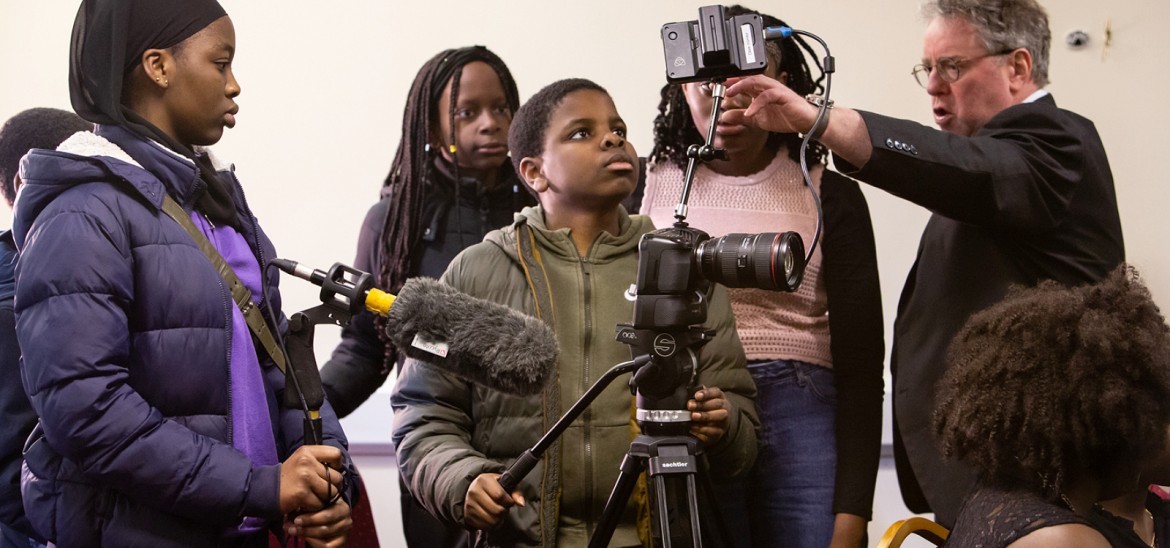
Last week we submitted our response to the Call for Evidence from the Young Creatives Commission. The broad range of questions and framing in the context a growing acknowledgment of the importance of enrichment has us reflecting on how creativity can be made a meaningful and accessible part of every young person's life.
Into Film's response begins from a simple but powerful premise: that young people are not disengaged from creativity. On the contrary; they are immersed in it. Film, television, games and digital storytelling shape how they communicate, learn and interpret the world around them. The challenge is not one of interest, but of access. Too often, the opportunity to move from consumption to creation - from watching stories to telling them - is limited by factors beyond a young person's control. Even with the emergence of the creator economy, with its lower barriers to entry, it is not clear that people from medium to lower income backgrounds can access this economy compared to more privileged peers.
This distinction between consumption and creation is key. When young people are given the opportunity to engage actively with film and moving image arts, the impact is immediate and tangible. Learning becomes more dynamic, more collaborative, and more connected to their lived experience. Moving image arts can support literacy and communication, but they also create space for something less tangible, but equally vital: a self-confidence in expressing their own voice and a sense of belonging within learning. These are not peripheral outcomes; they are foundational to a young person's future.
And yet, as the Commission itself recognises, access to these opportunities is becoming more unequal. Cuts to arts subjects, declining provision in schools, and the erosion of local cultural infrastructure have created a landscape in which participation is increasingly shaped by postcode and privilege. For many young people - particularly those from disadvantaged backgrounds - creative experiences are no longer a routine part of growing up.
Into Film's submission highlights this growing 'enrichment gap' as one of the most urgent challenges facing the sector. Experiences such as visiting the cinema, taking part in workshops, or creating films are not simply enjoyable extras; they are the moments in which joy, creation and learning come together. They broaden horizons, raise aspirations, and help young people to see pathways to self-expression or careers that might otherwise remain invisible. Without them, education risks becoming narrower, less engaging, and less connected to their real lives.
Across all of the evidence we submitted, we kept coming back to one thing: a clear emphasis on the role of experience. There is a growing body of evidence, echoed in the Commission's own focus, that immersed learning, particularly when combined with exposure to real-world contexts and industries, has a deeper and more lasting impact than information delivered in isolation. Careers education, in this sense, is not simply about telling young people what opportunities exist, but about enabling them to encounter, explore and imagine themselves within those spaces.
For screen-related arts, this connection is especially powerful. As art forms as well as parts of a key industry, they offer a bridge between creativity and employment, between expression and future pathways. But without structured opportunities to engage, whether through school, extra-curricular enrichment or community provision, too many young people are excluded from that bridge before they have even had the chance to step onto it.
The Commission's ambition to place the arts on a par with sport provides a useful lens. In sport, participation is supported by sustained investment, local infrastructure, and clearly-defined pathways from grassroots to elite levels. By contrast, creative provision is often fragmented, dependent on shorter-term funding or smaller-scale initiatives. The result is a system that struggles to deliver equitable access for all.
Into Film's response argues for a different approach; one that sees creativity, including screen arts creativity, not as an optional extra, but as an integral part of education and youth development. This means thinking not only about what happens in classrooms, but about the wider ecosystem of opportunities that surround them: cinemas, discussion and maker clubs, community spaces, and partnerships with industry. It means recognising that access must be designed in as a system.
It also requires us to think carefully about who is currently missing out. The creative industries remain one of the UK's fastest-growing sectors, yet access to careers within them is still shaped by background, networks and early exposure. Without intervention, these patterns will persist. Ensuring that all young people can see themselves reflected in and connected to creative pathways is not simply a question of fairness; it is essential if the sector itself is going to thrive.
What is needed now is coherence. The building blocks are already there: evidence of impact, examples of effective practice, and a clear understanding of the barriers that young people face. The challenge is to bring these elements together into a system that is consistent, inclusive and sustained.
The Young Creatives Commission offers an important opportunity to do just that. By drawing together evidence, experience and expertise from across the sector, it has the potential to move the conversation beyond diagnosis and towards action. Its success will depend on whether access to creativity is treated not as an additional opportunity, but as a core part of the life of every young person.
If that principle is to be realised, then access to creative experiences, both appreciation and making, cannot just be something that happens if time allows, or funding permits, but something that is built into the fabric of education and youth provision from the outset.
Because the question is not whether creativity matters. It is whether we are prepared to ensure that every young person can access the creativity inside all of them.
Discover the ways Into Film is influencing and responding to policy and guidance across the education sphere.
View other Articles in this columnViewing 4 of 4 related items.
Find out more about our streaming service, designed specifically for UK schools.